*undskylder lige på forhånd hvis jeg lyder træls (heh, nordjylldand), men er lidt små træt 
Omegastuffy, hvis du læser den side du selv henviser til, så vil du se følgende:
Citér:
trapping and decoding of an AC3 signal taken to the S/PDIF digital-out - AC-3 decode function;
separate volume control for a central channel and a subwoofer one.
The most interesting function here is a software decoding of an AC3 stream directed to the S/PDIF-Out (DigitalOut) integrated into the driver. It, for example, releases a program DVD player from decoding of an AC3 stream by its own means and from a necessity to be informed about the current configuration of the acoustic systems connected to the card (2.0, 4.0 or 5.1): all parameters are set in the Surround Mixer program from the Live!Ware set.
|
|
|
Et stykke tid siden jeg var ordenligt inde i det, og kan helt ærligt ikke huske detaljerne, men her er lige en flok andre snippets (smider dem lige i quotes for nemhedens skyld):
Citér:
We designed the EMU10K1 to receive digital audio directly from devices such as CD-ROM and DVD drives. However, the samplerate of compact disc audio is 44.1 kHz, and the EMU10K1 output sample rate is 48 kHz. Due to manufacturing tolerances and drift, the clock frequency of each compact disc player differs slightly. Even if the output samplerate were also 44.1 kHz, the slight differences in clock frequency would cause the relative phases of the input and output sample rates to drift over time, eventually resulting in repeated or dropped samples.
It is possible to force the clock frequencies to be exactly synchronous by using a trackingphase-locked loop, or PLL, rather than a fixed-frequency oscillator.
Professional recording studios distribute a master clock to all interconnected digital audio devices, which derive local clocks from the master. This guarantees synchronicity of all digital audio streams. This approach is expensive and difficult, requiring PLL-based synchronization capabilities in all digital audio devices. Devices that cannot synchronize to an external clock source mustbecome the master clock source. This is a distinct disadvantage as there can only be onemaster clock at a time.
A better solution is to use sample rate conversion to resolve the incoming sample rate to the output rate. This requires a sample rate detector that continuously updates an estimate of the asynchronous digital input rate. The sample rate estimate maintains a phase accumulator that controls a 16-point Smith-Gossett samplerate converter. Such an asynchronous samplerate converter avoids the cost of a tracking PLLand provides support for multiple, simultaneous asynchronous audio streams. The EMU10K1 can support three simultaneous asynchronousstereo streams using high-quality asynchronous sample rate conversion. |
|
|
Citér:
Sample rate conversion
The EMU10K1 achieves relatively high-order multipoint conversion using Smith and Gossett’s particularly efficient algorithm of linearly interpolating the filter coefficients for convolution with the sample data stream. Rather than incurring the high cost of ideal conversion, the EMU10K1 uses a perceptual optimization technique so that most distortion componentsare inaudible. The key discovery was that most of the energy in real musical sounds is in the low-frequency band of human hearing. The images of these low-frequency components are located near multiples of the sample rate.
Designing the antialiasing filters to have deep notches at multiples of the sample rate at the expense of some additional high-frequencyaliasing significantly improves the perceived sound quality results.
Rossum, received a patent in 1992 for interpolation filters designed in this manner. The high-frequency alias components do not have a great deal of energy because the source material is music, which hasvery little information in the upper band.
....Consequently, the EMU10K1 wavetable synthesizer has higher sound quality than would otherwise be expected when using only 8 points for interpolation.All EMU10K1 sample rate converters use thesame technique. |
|
|
EMU10K1 bruger de, så vidt jeg er orienteret, i alle deres sound blaster kort!
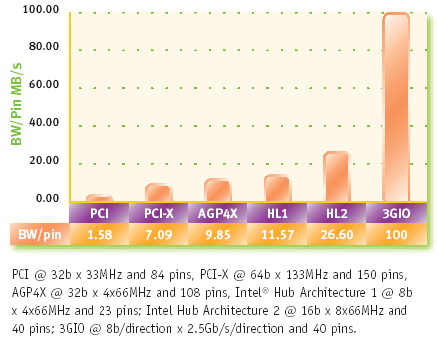
Noget der kunne være værd at overveje, er også, at pci-express produkter kommer på markedet i løbet af i år, hvilket effektivt vil nakke pci standarden, som har meget besvær med at følge med. Se forskellen i bushastigheden på billedet her under. PCI-express = G3IO
__________________
Individer, der residerer i transparente silikatbaserede domiciler, bør ikke tilrådes, at accellerere større eller mindre objekter af geologisk oprindelse.



 NAVIGATION
 Hjælp
Hjælp Chat
Chat Aktive emner
 Brugere
 Søg
Søg Opret ny bruger
 Log ind
 Emne: HTPC med god lyd?
 Emne lukket)


