Hej med jer
Her er artiklen fra www.tnt-audio.com:
DIY loudspeakers series - Part II
Cabinet wall materials under test
Loudspeaker Energy Preservation Society
Meets Again
minutes of L.E.P.S. second meeting
[Italian version]
Minutes taken by Mark Wheeler, Spring 2007
Your chairman is: Mark Wheeler - TNT UK
"Ladies & gentlemen, may we take the minutes of the first meeting as read? We proceed to the business of the second meeting... gentlemen, and ladies, START YOUR ENGINES"
"Aarrrrrgh...this is deafening", complain plebs, competing with the shriek of circular-saws, the whine of drills and the rasp of jigsaws, "Can't we do something civilised, like soldering, instead?"
"Ah, my fellow Audiophiles", shouts quoth ye ancient scribe over the din and apparently running for office again, "Our campaign against delinquent energy must make work for your idle hands too"
I wanted to know what materials to use to build my next loudspeaker project, back in the late 80s. I had read numerous magazine articles, JAES preprints, patent documents and manufacturers' advertisements, but there seemed to no consensus. Many writers or manufacturer's blurb made unsubstantiated claims, MLSSA was still being developed and the only objective test results seemed to be of steady-state measurements of single clamped panels, by the BBC and RCA labs in particular. Reports of the benefits of mathematical analysis of waveforms were devoid of published results in the public domain, presumably because the useful results of such expensive research was being kept secret from competitors.
In other areas of loudspeaker research steady state measurements were falling out of favour, being acknowledged as only a relatively tiny fraction of perceived music performance quality.
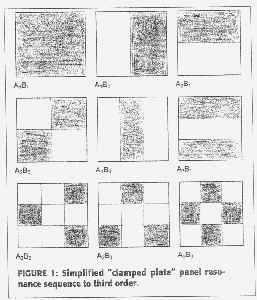
Most of what has been stated about cabinet wall behaviour arises from clamped-plate theory. Clamped-plate theory only explains the behaviour of clamped plates. It does not explain the behaviour of sheets of material glued at their edges (with glues that are inevitably flexible) to similar materials. Clamped-plate theory does, however, give us very useful clues to understand what forces a theoretical plate might undergo, and thus give a starting point to understanding what loudspeaker cabinet walls do when excited by pressure variations from the cabinet interior and impact vibrations from the driver basket. These two sets of forces exist in abundance in most moving coil loudspeakers across the bandwidth of any driver loaded by the cabinet. The impact forces also exist at any frequencies reproduced by any driver connected to the structure, even if not cabinet loaded; enclosed midranges or treble units, for example.
A few manufacturers had recently, at that time, made advertising claims that sounded promising. The Naim SBL (Separate Box Loudspeaker) claimed that mounting the treble-driver on a separate baffle & subassembly from the bass-mid driver reduced the intermodulation effect of the big bass excursions on the treble-driver chassis. The SBL went a step further by isolating the bass loading chamber from the bass-mid driver baffle subassembly by a compliant coupling, to reduce vibration transmission from driver basket to large radiating areas of cabinet walls. The Roksan Darius loudspeaker mounted the tweeter on spring suspension and the whole loudspeaker in an exoskeletal stand-frame, in a similar attempt to achieve similar ends. I was able to compare Naim SBL with Linn Sara and Epos ES14 in the same system (LP12/Ittok/Karma Naim NAC32.5/Hicap/NAP250 if I recall correctly) and I was sufficiently convinced by these demonstrations of energy control to conduct my own explorations.
Other manufacturers made much of their use of balanced-veneered chipboard (both sides veneered), the then new MDF (much heralded as an ideal loudspeaker material, particularly the Medite variety), birch plywood, and even aluminium and hardwoods. Kef had even offered the steel-baffled Reference 103, and many made much of the use of a circumferential brace around the interior of the cabinet. They couldn't all be correct, and I was planning to construct a pair of state-of-the-art tiny footprint wall-proximity loading speakers with no compromises except that small footprint.
What these impressive designs seemed to have been considering for the first time since Gilbert Briggs' sand filled baffles, were the paths by which energy may be controlled or marshalled. The SBL, for example, seemed designed to keep energy marshalled on the straight and narrow path of righteous steel frame rather than dissipated in wastrel wafts of panel resonance.
Method
The chance opportunity to disembowel a pair of Mission 735 (a respected 2-way just below the 770 in the early Mission range) allowed a series of prototype cabinets to be built, each a one-off to be compared subjectively with the remaining original. The original would be the reference in each pairing playing mono signals and differences written down. The boxes were all the same internal size as the original, each used a port (plastic drain tube) of the same dimension as the original and each was stuffed identically with polyester (the other original's polyester was moved at the same time as the bass-mid driver. The crossover was mounted externally and the tweeter stood on top squidged into some plasticine, to speed the changeover process.
The manufacturers' original was similarly modified; tweeter hole blanked off and tweeter squidged on top with plasticine. The internal wiring matched with the prototypes using Kimber hook-up wire. Two variables between prototype and original were thus eliminated.
BBC research had identified 12mm birch plywood, heavily damped with bitumen pads, as providing the cleanest, most accurate midrange. Yet most manufacturers continue to strive for thicker, stronger walls. I wanted to know why. So a prototype was built with 12mm panels, unbraced but loaded with dedshete pads (a combination of foam and bitumen felt). Corners were reinforced with quadrant rammin bead. Genuine plywood of birch all-the-way through, rather than birch faced, proved to be a special order item locally. The driver lead-out wires simply passed through a hole filled with a blob of bath sealant.
As predicted, the midrange sounded much cleaner in the 12mm damped birch-ply cabinet. The bass though, was if anything, slightly slower sounding than the Mission original. At the time I wrongly believed bass speed to be mainly a function of bass loading (cabinet volume, port size and stuffing), so this raised more questions than it answered. The bass also had a plummy one-note quality from the 12mm birch-ply boxes, quite unlike the drier bass becoming fashionable at that time in the late 80s. Both the prototype and the original exhibited clearer treble than our memory of the unmodified original, which we guessed was due to the tweeter and crossover no longer being mounted in the bass enclosure.
A similar unbraced 18mm medium density fibreboard (MDF) cabinet was built and tried. 18mm was chosen as it was the only grade at the local timber merchant (lumberyard) and also 18mm seemed to be popular with early adopter high-end manufacturers choosing to use mdf. The bass was slightly better than both the 12mm birch-ply prototype and even the original Mission's 15mm chipboard (material from memory now, they went back to their owner years ago). However, the surprise was that the mdf cabinet also seemed to impose a leaden quality over the music.

My friends and I had expected the MDF to be superior to both the chipboard cabinet and the 12mm birch ply, because MDF was now the magazines' flava of the month while birch ply had emerged tests more than 10 years previously. Our experience was very different. MDF seemed to suck the life from the music compared to the original chipboard box (15mm if memory serves me, the 735's were returned to their owner in about 1988). We then dismantled the Mission reference so we could A-B compare the 18mm MDF carcass directly with the 12mm birch ply carcass. I wanted to eliminate the 15mm chipboard middleman.
The direct A-B, indeed MDF-BB (traditional birch-ply grade) confirmed the first impression. In every respect other than bass, the birch ply was superior. Instrumental timbre accuracy was superior in the BB cabinet, midrange colouration was lower, hence voices clearer and seeming more tuneful. However, the 18mm MDF seemed to have more neutral and faster bass than the damped 12mm birch plywood, but both had obvious faults. While the plywood cabinet speaker had cleaner clearer midrange and generally more lively presentation it exhibited a bloated upper bass quality that seemed a drag on the rhythm. The 12mm birch-ply cabinet upper bass-bloom could be listened through, being so distinctive and constant, but the effect on rhythm is undesirable enough to prompt further experiment. The 18mm MDF seemed even more lacking in life than the plummy 12mm Birch-ply, even though it produced superficially tighter faster bass, the whole effect seemed to have the lifeblood sucked out as though by some urea-formaldehyde sucking vampire.The birch-ply did seem to have better signal-to-noise ratio, although this may be illusory as I have never seen any measurements to confirm it. Adding dedshete pads to the 18mm MDF cabinet made very little difference that none of us could have identified blind.
I managed to source some 25mm MDF, and had already ordered 25mm birch ply at the same time as I ordered the 12mm sheet (despite sheet material thickness being always now described in mm, in the UK sheet timber materials are confusingly sold sold in traditional eight-by-four foot sheets, 2.44X1.22m, providing plenty for these experiments) so similar internal dimensioned cabinets were made from these materials.
At 25mm panel thicknesses, the gap narrowed between the MDF and the plywood. The 25mm versions of both materials were superior in bass quality to either the 18mm MDF or the 12mm birch ply. This simply indicates that when all else is equal, thicker cabinet walls make batter bass. The 25mm birch ply was possibly superior to the 25mm MDF for bass articulation, but it was hard to separate the bass quality from the rest of the reproduction as the 25mm MDF also suffered from the same leaden quality as the 18mm MDF cabinet had suffered. Birch-ply rhythm and pace were orders of magnitude better than MDF.
The 25mm birch ply cabinet was slightly inferior to the damped 12mm birch ply cabinet in the midrange. Most listeners to this comparison noted that the 25mm ply had a more forward quality than the damped 12mm panels, that made vocals less natural, even slightly nasal. I wondered whether this contributes the sublime vocal quality of my father's LS3/5a speakers as much as the complicated crossovers and rigorous component matching.
The owner wanted his Mission 735 back and experiments had to be conducted on another pair of donor speakers, Mission again. Mission had been flava of the month for a while and used base models were very common and very cheap and were chosen for this reason alone.
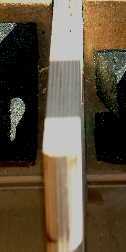
Various other subjective experiments were conducted and results broken down. These results are specific to these experiments:
- Thicker walls make better defined bass, whatever the material
- Damped thin-wall birch-ply makes the least midrange colouration
- MDF sucks the life out of the music in each type we tried
- Thicker baffles retrieve more musical information at all frequencies
The last point applies even with an otherwise thin-wall midrange cabinet. One experiment had one bass-mid driver in a 25mm birch-ply box and the other bass-mid driver in a damped 12mm birch-ply box and an active crossover feeding below 400Hz to one and above 400Hz to the other. This gave the best results so far, and then when another 12mm layer of birch-ply was glued to the baffle it improved further.
Not having the means to test why these preferences should apply, I can only offer hypotheses. I suspect the better bass definition and better rhythm and pace from the 25mm thick birch-ply prototypes is due simply to their greater rigidity. If the fast fluctuations of air pressure in the box cause the cabinet walls to flex out and spring back the non-linear slightly delayed changes in air pressure will act on the back of the cone, causing it to move in a manner unrelated to the input signal. Bass transients will ring, leading edges of bass notes will become smeared and the intermodulation of the reflected frequency on its original (at many frequencies simultaneously of course) will generate beat notes at sums and differences of their frequencies and phase. This might explain why bass seems more tuneful with the 25mm birch-ply cabinet, it is far easier to determine the pitch of short notes via the 25mm walled cabinet than the 12mm walled or the 18mm mdf walled cabinet.
The success of the damped thin-wall cabinet for midrange might be simply because its lower mass causes less stored energy, and what energy is stored gets reduced by the damping.
"Oi! Hang on a minute" shout plebs, stage left, "He said that damping was a bad thing in part 1; don't you remember? He was either lying then, or he's lying now!"
Yep! part 1 of this series was written with the benefit of many further years of speaker building activity after these experiments took place, the results of these experiments represents the state of my art in 1988. Later experiments in parts 3, 4 and 5 reach the point where a lossy wall damping pad have no audible effect. The doubling of baffle thickness on the 12mm cabinet was just the first successful step.

Conclusion
With a bass-mid driver handling everything from the lowest bass up to around 2kHz, it seems like the domestic speaker builder just can't win. For top midrange performance choose a carefully damped lower-mass material of consistent stiffness, like 12mm birch plywood. Voices are more natural, better articulated and other midrange instruments seem to have more accurate timbre with heavily damped 12mm birch-ply, but could be even better when we find out how to achieve similar without lossy damping.
For tight accurate bass, a heavier rigid material, 25mm birch plywood, provides the cleanest, fastest, most tuneful bass. Experiments with other 25mm materials (MDF and 'far Eastern ply') were not far behind the birch ply at the lowest end of the spectrum, perhaps below 300Hz. However, this was difficult to evaluate with a single driver handling up to 2kHz. More cabinets and tighter bandwidth gating later offer more data. In the late 80s I could only try the 2 cabinet experiment with birch-ply of 12mm and 25mm. MDF of both 18mm and 25mm thicknesses seemed to have a singularly unfortunate effect on music, even compared with conventional chipboard, which one might expect to be similar, but was actually very different in character.
That MDF has been almost universally adopted by the loudspeaker industry might have more to do with its cost-effectiveness. It is very easy to machine and manufacture to a very high standard of accuracy and finish, whereas birch plywood and solid hardwood is expensive to buy, even more expensive to cut or machine accurately and does not lend itself to v-groove&fold construction, which is a very cost effective large number cabinet manufacturing technique. These tests are for DIY and take no account of materials cost or time cost or failure rate.
The worst conclusion was that I had nearly completed 80litre 18mm mdf enclosures for my Decca London Ribbon & Focal 10N501 project and had already partly veneered them in Australian walnut. Only the baffles remained to be glued in place, so I immediately embarked on a series of experiments to explore the relative merits of various techniques and materials for bracing cabinet walls.
Subsequent speakers that were designed and built from scratch after all this research used heavily braced all 25mm birch ply cabinets, heavily braced so that spans between braces are never more than 75mm across. These used the polypropylene coned Scanspeak 18WPP bass-mid driver and the Elac metal dome tweeter. The knuckle-rap test produces the sharpest result I have ever heard and the sealed enclosure Q=0.5 alignment made the fastest bass I had heard from a direct radiating moving coil driver. The cabinet dimensions and sloping baffle worked perfectly against a wall (though the wall-proximity soundstage limitations were exactly as you expect) and were absolutely perfect, veneered in figured Yew, for a couple who wanted speakers to match their other furniture and not intrude into the floor space, being fed by top-spec Linn front end and classy electronics.
That combination of drivers and cabinet technology produced a speaker capable of splendid microdynamics whatever the conditions, facilitating wonderful listener insight into subtle aspects of performance and recording location. The above experiments proved very useful in guiding the design decision process and leading to more questions that would result in more experiments.
Despite less high-tech resources the home constructor can conduct original research, which may be more relevant to him or her, to help guide design and construction decisions, rather than rely on published research more suited to production in the commercial domain.
To summarise, in these experiments, for low frequencies below perhaps 300Hz (I did not explore different frequencies, so a bass-to-mid crossover point anywhere between 200Hz and 400Hz would probably suffice) 25mm materials of any type were better than thinner materials of any type. Birch-plywood (void-free birch all the way through, sometimes known as BB grade) was slightly better then the much cheaper mdf; birch-ply also has no health hazard rumours, but is more difficult to work. You pay your money and you make your choice. I now choose birch-plywood anywhere that I am not using solid hardwood.
For midrange frequencies, 12mm birch ply loaded with foam+bitumen sheets sounded clearest in our little experiment. The human voice range sounded most natural with this cabinet configuration. Voices singing have much of the energy concentrated in the decade from about 500Hz to 5kHz, even though bass voices can reach fundamentals of around 100Hz, tenors 165Hz and even sopranos lower than 300Hz, the lowest fundamentals of each human sound are isolated 20-23dB peaks at the lower end the spectrum analysis (Driscoll p51) with the centre of a bell-curve cluster of harmonics typically a decade above fundamental (i.e. bass voice 1kHz, tenor 1500Hz, soprano 3kHz), many harmonics 12-15dB in amplitude. The 15mm chipboard official cabinet was obviously inferior in the midrange. All thicknesses tried of mdf squashed the life out of the music, but fear not if you have mdf cabinets; I will explain how to rescue them and give them a new lease of life in a future article.
For now, if you are planning a new project, or rehousing some familiar drivers, the message is simple, the home constructor has the time and resources to build far superior loudspeaker cabinets to any that can be bought ready-made at real-world prices.



 NAVIGATION
 Hjælp
Hjælp Chat
Chat Aktive emner
 Brugere
 Søg
Søg Opret ny bruger
 Log ind
 Emne: Suger MDF livet ud af musikken?
 Emne lukket)


